
Flagship idea
The Polymorphic Organisation
Most organisations were designed to hold their shape.
But when technology, talent, markets and expectations keep moving, the ability to change shape becomes an organisational capability in its own right.
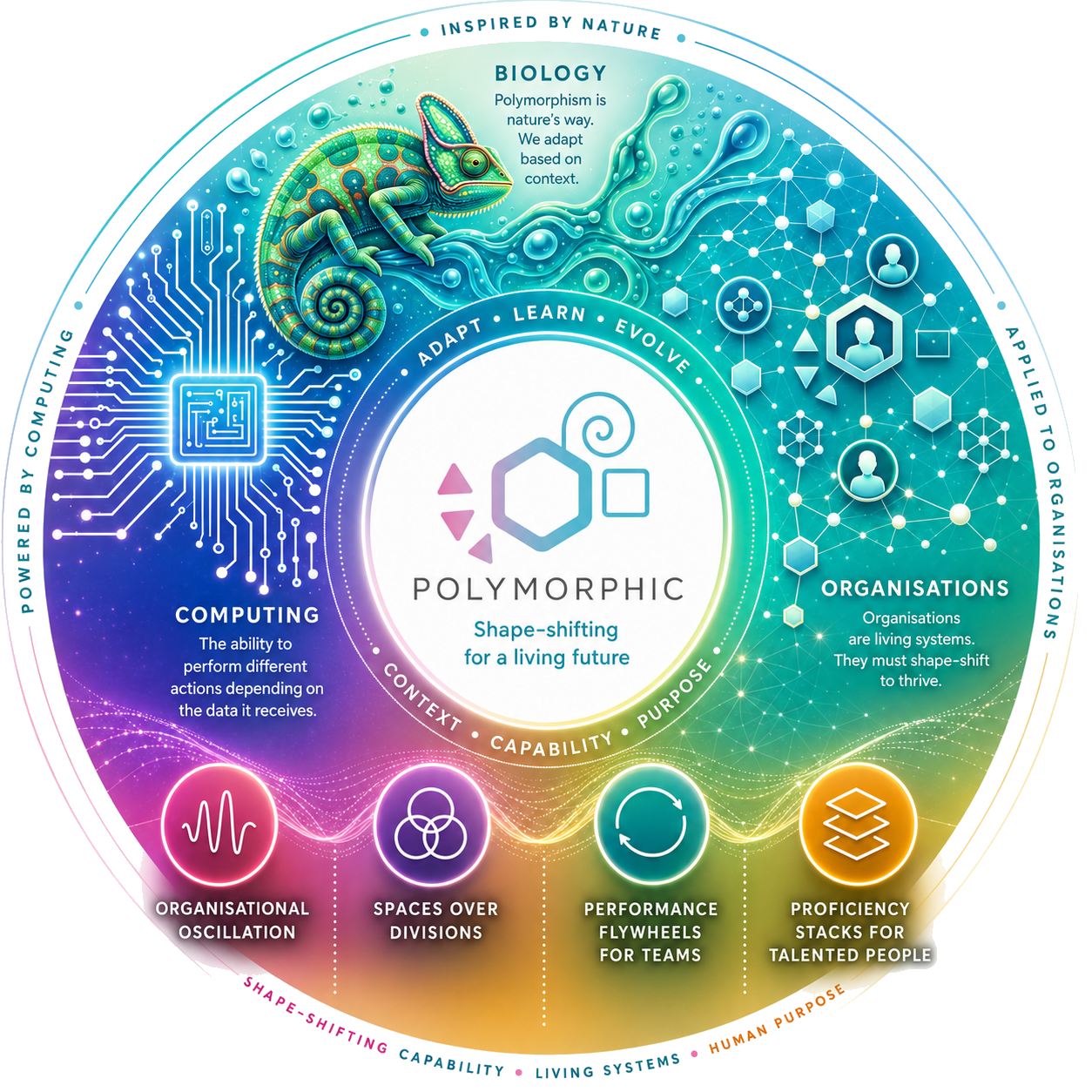
We call this the Polymorphic Organisation: an organisation able to continually reconfigure its work, talent, teams and structures around what the moment requires — without losing its purpose, coherence or humanity.
Four principles
Purpose → work → agency → learning → adaptation
01
Shape follows purpose
Structure is no longer something to defend. It becomes something to deliberately configure — and reconfigure — around purpose, context and the work that matters.
02
Work over jobs
Work is decomposed into skills, missions, problems and outcomes. Talent can flow towards where it creates most value, rather than remaining trapped inside jobs and organisational boxes.
03
Authority follows the work
Information, judgement and decision-making move closer to the people doing the work. Teams gain greater agency while remaining connected through clear purpose, evidence and accountability.
04
Evidence drives evolution
Polymorphic organisations sense as well as plan. Signals from people, performance, customers and the wider system create continuous feedback — allowing the organisation to learn, adapt and evolve.
The organisation becomes a living system
This isn't perpetual restructuring.
It is the deliberate development of an organisation capable of changing form without losing itself.
Organisational Oscillation
Knowing when to expand, experiment and explore — and when to consolidate, integrate and stabilise.
Spaces over Divisions
Creating fluid organisational spaces around purpose, problems and value rather than relying solely on permanent functional boundaries.
Performance Flywheels for Teams
Replacing episodic performance management with reinforcing loops of clarity, feedback, learning and momentum.
Proficiency Stacks for Talented People
Building evolving combinations of skills, knowledge, experience and contribution rather than defining people through static job descriptions.
The enabling architecture
HR 3.0 — the operating substrate
A Polymorphic Organisation needs something underneath it that makes continuous adaptation possible.
HR 3.0 is that operating substrate. It connects people science, organisational design, data, technology, skills, culture and leadership into an architecture that enables the organisation to shape-shift safely and intelligently.
The People function therefore moves beyond administering employment.
It becomes an architect of how work, people and organisation continually evolve together.